AIML – BioDoc: Development of AI and Machine Learning Imaging Applications for Bioresource Identification and Documentation in Nigeria.
AIML – BioDoc (Artificial Intelligence and Machine Learning for Bioresource Documentation) is an initiative led by Nigeria that aims to revolutionize agricultural productivity, food security, and biodiversity conservation using AI-driven imaging applications. The initiative is led by the National Biotechnology Research and Development Agency (NBRDA) and aims to address the systemic issues that arise from inadequate bioresource identification, poor documentation, and ineffective phenotyping practices.
The Nigerian agricultural sector is characterized by small-scale farmers who depend on visually evaluated planting materials, seed systems, and extension services. The identification of viable seeds and crops results in poor germination rates, low crop yields, crop failures, and economic losses, which affect food security and the livelihoods of farmers. On the other hand, the rich biological resources of Nigeria, such as indigenous crops and species, are not well documented.
Nigeria already has valuable bioresource assets in the form of the National Centre for Genetic Resources and Biotechnology (NACGRAB), which has large repositories of diverse plant genetic resources, including indigenous, rare, and valuable species. However, much of this existing resource is limited by a lack of digital phenotypic description and the lack of scalable identification systems. AIML – BioDoc directly leverages these existing national resources by using AI imaging systems to improve the accessibility and usability of NACGRAB’s plant resources.
AIML – BioDoc addresses these challenges by creating AI and ML image applications that are capable of accurately identifying and classifying bioresources through high-resolution images taken in controlled and field settings. The application identifies important phenotypic characteristics such as size, shape, color, texture, and structure, and applies supervised and deep learning algorithms, including convolutional neural networks, to automatically identify and document the bioresources.
The project brings together data gathering, annotated image databases, feature extraction, machine learning memory, and incremental learning for adaptability to new varieties and environments. Through the incorporation of feedback loops and transfer learning, the platform enhances accuracy levels while increasing the knowledge base. The application is made user-friendly and deployable on accessible devices to ensure usability by researchers, extension agents, and farmers.
In addition to identification, AIML – BioDoc promotes sustainable consumption and production patterns through the reduction of waste, enhanced traceability, and the use of data-driven decision-making in agricultural and bioresource value chains. This initiative also enhances conservation efforts by promoting the long-term monitoring of bioresources and the health of ecosystems, in addition to national conservation agendas.
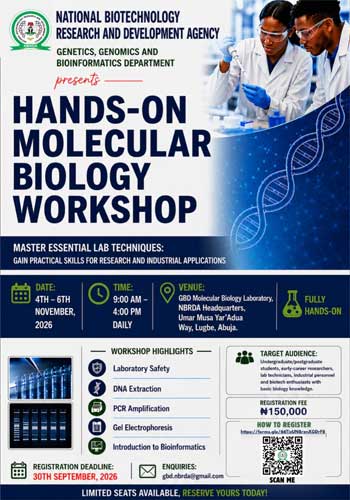
Capacity building is at the heart of this initiative. By training, workshops, and curriculum development, AIML – BioDoc inculcates indigenous knowledge in AI, ML, and computer vision and encourages inter-disciplinary work among biologists, data scientists, and policymakers. Open science practices are encouraged by making datasets, models, and documentation protocols publicly available.
Through the alignment of technological innovation and societal needs, as well as the use of existing national bioresource collections, AIML – BioDoc is an example of the vision of science as a driver of inclusive, ethical, and sustainable development, as outlined in the International Decade of Sciences for Sustainable Development.
Email: gbd@nbrda.gov.ng